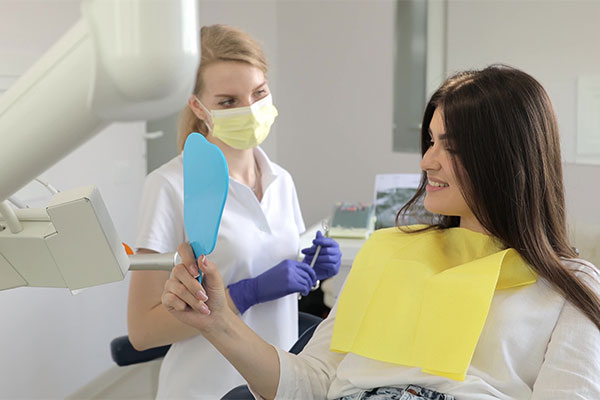
You can have restorative dental procedures from your general dentist to replace defective or damaged parts of your teeth. Restorative procedures are used to replace broken or missing teeth and are among the most common treatments and procedures that dentists handle regularly. They restore the function and aesthetics of teeth and supporting structures while helping people feel confident about their smiles once again.
Fillings
At any given moment, a person's mouth has a pretty good amount of bacteria in it. Over time, this can erode the enamel and dentine making it possible for cavities to form. Fillings are used to cover up large defects in tooth structure caused by cavities and protect the tooth from further damage. The great thing about advancements in filling materials, they can now match the color of your teeth. This means that it is less obvious that you have fillings at all.
How is it done? The general dentist first removes the decay from the tooth. Next, is sterilization using an acid gel. Then, the dentist proceeds to restore the tooth structure with filling materials. The process is fairly simple and straightforward. You should expect your mouth to remain numb for some time following the treatment, and you'll want to avoid especially hot or cold foods.
Filling materials can be made from different substances. This includes:
- Glass ionomers
- Composite resin
- Gold
- Silver
- Plastic
- Mercury
Each has its advantages and disadvantages, which your dentist can go over with you. It's ideal to consider each pro and con so that you can make the most informed decision regarding your dental health.
Teeth straightening
Teeth straightening is a procedure used to correct misaligned or crooked teeth. Many people feel that teeth straightening not only repairs their smile but boosts their confidence. Teeth can be straightened using braces, veneers, clear aligners, retainers, and headgear depending on the condition of your teeth. The result is a beautiful smile that you can be proud of!
Braces, either metal, lingual or ceramic, are worn to slowly move the teeth in the proper position. They are worn for a certain period, and they gradually move the teeth into position. Clear aligners serve the same purpose but are more aesthetic as they are nearly invisible. Retainers are used after braces or clear aligners to retain the teeth in position once straightening is complete.
Veneers
Veneers are used to replace cracked, broken, or discolored teeth. The dentist can cement them directly on your teeth. It can be done by first taking an impression of your teeth, and constructing a veneer that fits the impression made before inserting it into your mouth.
Crowns
Crowns are artificial structures that closely resemble the crown of the natural tooth. They can be used alone for crown replacement procedures or used as part of dental implants and bridges. They can be made from different materials such as:
- Porcelain
- Stainless steel
- Zirconia
- Silver
- Gold
- Resin
How is it done?
You may be surprised to learn that the process for dental crows is incredibly thorough. Each step helps ensure that your smile is at its best. Here is the process for getting dental crowns:
- Tooth radiography is first done to examine the state of the tooth
- The general dentist proceeds to treat any active inflammation present
- Next, they administer anesthesia to numb your tooth
- Reshaping and filling take place so your tooth can fit the incoming crown
- The dentist takes an impression of your teeth and sends it to the laboratory to make a customized crown for you.
- On another appointment, the dentist places the crown over the damaged tooth.
Implants
Implants are restorative options for missing teeth or teeth that many people select. Implants are a more ideal option than dentures simply because they stay in place making it easier to take care of them. They have the crown (the visible part above the gum) and the implant body inserted into the jawbone and gum. It serves as the point of attachment. Implants replace the gap in dentition and prevent the buildup of food particles and subsequent inflammation.
Where to start with restorative procedures
As you can see, there is more than one way to restore your smile. Any of these options can serve as restorative measures for replacing missing or damaged teeth to get you back to looking and feeling your best. Talk to your dentist about which options are right for you. Ultimately, you'll walk away with a new and improved smile.
Request an appointment here: https://dentalstudiocolleyville.com or call Dental Studio Colleyville at (817) 885-5188 for an appointment in our Colleyville office.
Check out what others are saying about our dental services on Yelp: Restorative Dentistry in Colleyville, TX.
Recent Posts
A dental crown can help restore the appearance and function of your smile while improving your oral health. Working with a restorative dentist can streamline the process. Here are a few benefits of getting a dental crown from a restorative dentist.Healthy teeth feature an outer shell known as enamel, which protects the underlying dentin. Though…
A restorative dentist plays an important role in dental health and aesthetics. Damaged or missing teeth can impact a smile's appearance and cause problems for oral health and function. This is why restorative dentists offer a range of repair and replacement procedures to keep a patient's smile looking and feeling the way it should.A restorative…
Dental restorations offer ways to preserve your teeth and take care of your oral health even when signs of decay begin to occur. A problem might start out as a very small cavity, but if you have not kept up with regular dental appointments and did not notice any pain, it is possible you may…
A broken tooth might not seem like a big deal if it is only a minor break, but it still requires treatment. This is because broken teeth cause more damage than simply ruining the appearance of a person’s smile. The damage typically removes portions of the outer surface of teeth, called enamel, which protects the…